DLL€4,000
Insights
Experience vendor-neutral model-based digital collaboration simulation in Graz.
- Deep-dive session
- Hands-on collaboration simulation
- Silo-free communication models
- Duration
- 3 Hours
- Group size
- 1–8 people
Break down expert silos. Connect your teams, processes, methods and tools in a physical lab built for hands-on systems engineering.
The Digital Lifecycle Lab is more than an installation of software tools. It is a physical, fully connected environment in Graz, Austria, equipped with the latest hardware and software technologies.
Experience an integrated environment where proven methods and organisational best practice come together, and see how fragmented toolchains become one connected workflow.
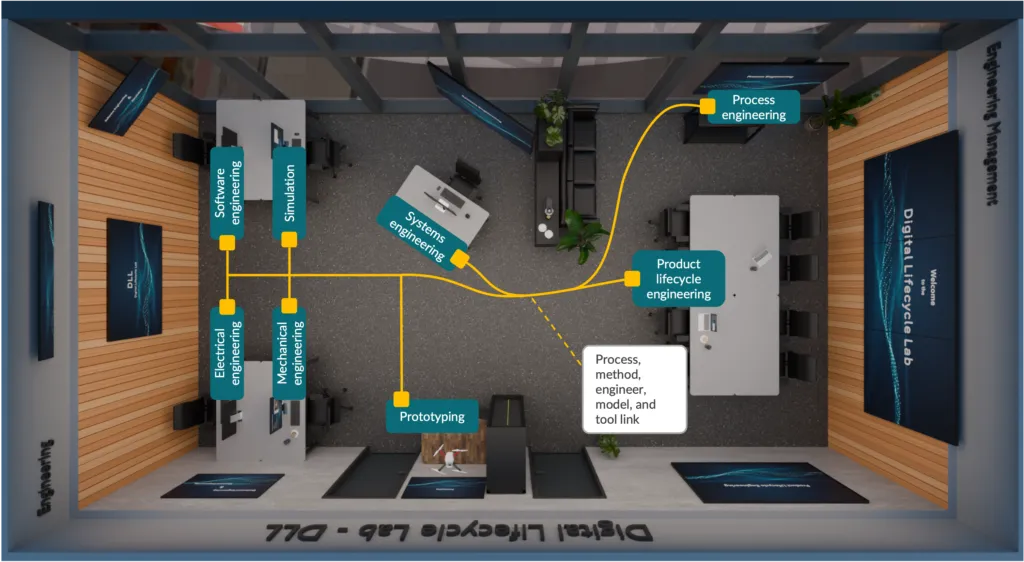
Select a pillar to read more.
Digitalization is not a technical project, but a cultural shift. It is the transition from disconnected silos to a unified, transparent engineering lifecycle. By aligning the collective mindset with shared purpose, we move beyond legacy structures, ensuring that collaboration is not just a process to be managed, but the natural, integrated state of how we build and innovate.
Digital collaboration only works when all four pillars are in harmony.
Teams work in isolated systems. Critical design updates are passed manually via emails and spreadsheets, losing context along the way.
Friction-Heavy Lifecycle
The point where culture, process, organization, and infrastructure act as one, the operational result of our four pillars working in concert.
Simple and lightweight
One product, three disciplines: mechanics, electronics and software.
A search-and-rescue drone is deployed in the hot summer heat to locate missing hikers. Under the heavy, continuous climb, the drone overheats and fails.
Drone crashes. Hikers remain lost.
Requirements reside in static documents, electrical wiring schemas are kept in spreadsheets, and mechanical layouts are stored in isolated local CAD directories.
In an environment built on our four pillars, fragmentation gives way to a unified ecosystem:
How a session unfolds, from welcome to wrap-up.
Step 1
Arrive at the lab in Graz, meet your hosts and set expectations for the day over coffee.
Step 2
We align on a realistic mechatronic reference project and outline the cross-discipline engineering hurdles we will solve.
Step 3
Experience the connected toolchain and its methods live: change a requirement and watch the update travel through the ecosystem.
Step 4
Time for a technical deep-dive on the topics that matter to you, such as the mechatronic lifecycle or interface validation.
Step 5
We review what you learned, hand over documentation and agree on concrete next steps.
Formats for every team size and goal. All times are Graz time.
Experience vendor-neutral model-based digital collaboration simulation in Graz.
Full-day alignment workshop analyzing tools and cross-team communication pipelines.
Access the lab as your own group workshop space with optional collaborative guidance.
Guided testing and verification of your individual collaborative team paradigms.
Remote live feed tour and collaborative tool integration demonstration.
Experience vendor-neutral model-based digital collaboration simulation remotely.
On the Inffeld campus of Graz University of Technology.
Enter the building Inffeldgasse 21b, take the lift or stairs to the 2nd floor and follow the signs to the lab.
Tram line 6 to St. Peter Schulzentrum, then a 5-minute walk. Visitor parking is available on campus; please register at the barrier.
Map is provided by Google. Loading it sends your IP address to Google.
A collaboration between industry and research.